
How to Tune a 1.6 Miata (NA6)
Years ago there was a site called solomiata.com, and it was the best resource for people who wanted to tune their 1.6 Miatas. Later the author added information for 1.8s. The site was down, it was back up, it was down, and now it lives over here.
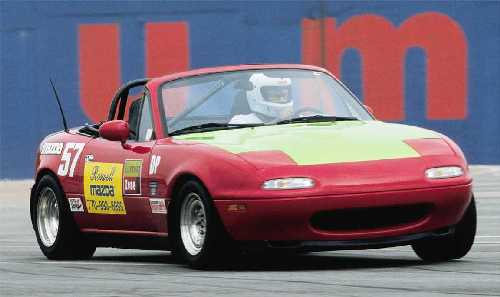
The Solomiata recipe for cheap horsepower was:
- Advance the timing 4 degrees, for about + 2 hp.
- A cat-back exhaust, for about 4-5 hp.
- Replace the AFM with a larger flapper valve from a RX7. The standard Miata flowmeter is too small to flow at high RPM, and so this added 5 hp above 6000 RPM.
- Aftermarket header for another 3-4 hp.
- Add a programmable ECU, larger injectors, and an adjustable fuel pressure regulator.
- Shave the head .010″ for about 4 hp.
All of that would get you a maximum of 115 hp at the wheels. I think a more realistic estimate is 108-112 hp based on most stock 1.6 Miatas dynoing around 92 hp stock, and our cars being a lot older at this point.
The modern Solomiata formula
That was then, what do people do now? Swap in a VVT 1.8. A bone stock NB2 motor will put out similar horsepower as the Solomiata formula, and way more torque. I drove Napp Motorsports’ VVT swap back to back with my well modified NA6. My motor has only 5 hp less, but the torque difference was astounding, like it was a completely different car. It was the lightbulb moment where I was like “I made a huge fuggin mistake.”
However, if you aren’t ready to take the motor swap plunge, here’s the modern Solomiata formula for a 1.6 Miata.
- Standalone ECU. I got a Megasquirt PNP2, which is about $800, but these days you can buy a Speedy EFI unit for half that. It even comes with a variable TPS (the 1.6 Miata has an on/off throttle position sensor). A standalone ECU combines steps 1, 3, and 5 from the Solomiata formula.
- Cold-air intake. If you want to keep the stock airbox, get a cowl intake (Randall or DIY a snorkel). If not, find someone to 3D print you an intake.
- Cat-back exhaust. There are many to choose from. Optionally replace the catalytic converter with a high-flow cat for another 1-2 HP. Your OEM cat is worth over $100 at any scrap yard, so that will defray the cost.
My car with only a MS PNP2, cone filter, and cat-back exhaust pulled 106 hp on a Dynojet. I hadn’t decked the head at that point, but if I had, I’d be right in the Solomiata ballpark.
All of these mods can be done cheaper and easier than a motor swap, with about the same result. You won’t have shit for torque, but you’re used to that, right? You might have noticed I didn’t add a header to this list. The reason being, that’s specifically a 1.6 part and won’t work on a 1.8. You can do all of the mods above and still come to your senses and do a 1.8 VVT motor swap.
Up to this point you won’t need to dyno tune your car, either. You can use the ECU’s base map, as its programmed for mild bolt ons. But if you modify the car further, you’ll need to tune the ECU. And that’s where things get difficult. Not the tuning itself so much, but because the 1.6 head doesn’t flow well. Quality control on these heads wasn’t great, and there’s a lot of core shift between different heads, and the port geometry could be improved (and later was).
You might think that the shorter stroke means you could go after high RPMs, but if you do that, then the oil comes out of the hydraulic lash adjusters. So there’s a low ceiling on how far you can tune a naturally aspirated 1.6, both bottom end, and top end.
This is a smart place to stop modifying your normally aspirated 1.6 and look for a junkyard NB2. Unless you need to replace a head gasket or remove the head for some other reason, this is a smart place to stop reading.
I don’t care, I’m tuning a 1.6
If you’re going to modify a naturally aspirated 1.6 Miata any further than this, then you’re already beyond reason. If logic worked, it would have worked already. But misery enjoys company, so thanks for joining the club.
OK, so let’s do this. The next thing you need to do is pull the head. An older engine may need a valve job, and you can get a lot of things done at the same time.
- Number all the valves and their locations and remove them (socket and hammer trick.) Clean up the ports with a Dremel tool. It’s free HP for a bit of your time. Remove casting flash, smooth any hard edges around the plunge cut, and blend the web between the ports. Polish the exhaust side, but leave the intake side a bit rougher.
- Take the head to a machinist and have them measure the valves and springs. Make sure to order new OEM valve guide seals. You might consider +1mm intake valves, this will add about 4 hp and torque. In any case, have them do a valve job.
- Have the machinist deck the head .040″ to bump up compression by one point. I’ve heard of people safely taking off more than that, but on Premium pump gas, you really don’t want to go much further. This will also retard cam timing a few degrees, which also helps. FWIW, there’s no bigger bang for the buck than decking the head, it cost me all of $50. If you need to replace a head gasket at any time, just deck the head and start using premium gas. I’d do this even on a bone stock NA Miata.
- Next is cams. The cheap way is an exhintake cam, modifying a MX-3 cam and putting that on the intake side. This gives about 8 hp when properly tuned. Or you can get a Kelford cam and double it. I went with a 203-B cam, which is about max for the street. A larger cam will have a rough idle, and you’ll need to replace valve springs, retainers, etc.
- With all that work into the 1.6 head, put on an aftermarket header. I have a Racing Beat in my race car and a Raceland in my street car. One of the welds failed on the Raceland, and the header was replaced for free. However, it was a hassle, and when you look at the difference in quality between Racing Beat and Raceland… well, you get what you pay for.
- Tuning is a must at this point. Reprogramming the ECU can range from free (your laptop) to $600 or more (dyno operator).
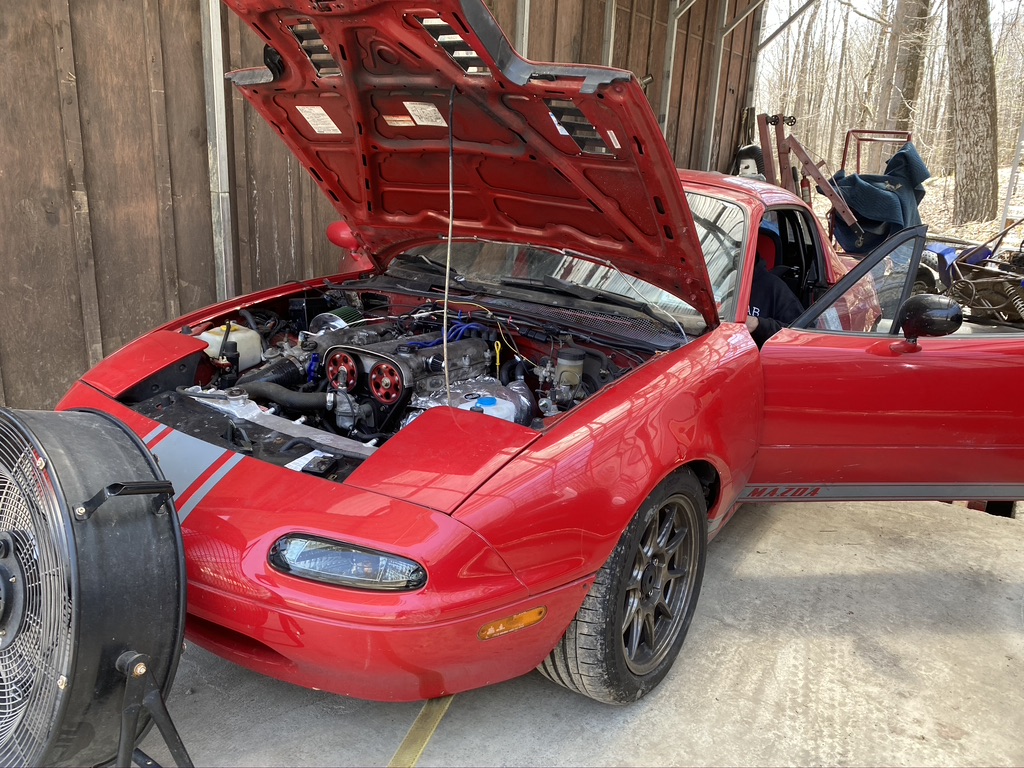
This is pretty much where my car sits right now, with 129 hp on a Land and Sea dyno (which reads like a Mustang). This equates to about 145 hp and 122 ft-lbs on a Dynojet. An NB with all the bolt ons will have slightly less horsepower and more torque, and overall similar performance.
If you’re wondering how this car stacks up against a K24 Miata, there was this one time, on a short track, where the little 1.6 came out on top.
Where next, NA6?
OMFG you’re still reading? The smart people left the room a while ago. They swapped in a NB2, Honda K motor, Ecotec, or used forced induction.
Speaking of forced induction, the Miata 1.6 engine was originally designed for a turbo. Back then people would complain about turbo lag, but modern turbos with standalone engine management offer instant throttle response, fat torque, and a top end rush. My teammate’s turbo NA6 turbo is in my garage right now, so I know what a good turbo feels like.
But I don’t want a turbo. I can’t answer that logically. Somehow I’m keen to get a supercharger, even if it’s not as good. And then part of me just wants to see how far I can push the normally aspirated 1.6 envelope. I guess I’m a glutton for punishment and disappointment.
So let’s say we continue this normally aspirated experiment, just as a thought exercise. Where do we go next?
- Intake manifold. The NA6 intake manifold is a single cast piece, so you can’t pull it apart and polish the runners or add volume with a plenum spacer. There are some things that can be done here. None of it is money well spent, but that ship sailed a long time ago. You can also use a NB6 manifold (JDM, EUDM), which gives you the ability to use the larger 1.8 throttle body, or even upsize to the Skunk2 throttle body.
- Extrude hone. This is basically forcing liquid sand through the manifold, which polishes the places you can’t reach. I would expect at most a 5% gain in power for $500.
- Manifold spacer. A piece of phenolic machined to the dimensions of the intake manifold runners would help lower intake temperature and provide longer runners. I’d probably have to space things out in the engine bay, and install longer studs in the engine. And there’s the issue of the injectors now being further from the port which might not be good for atomization.
- Skunk2. The Skunk2 intake manifold is available only for the 1.8 block, and adds 5-10% more power on the top end. Could this be adapted to a 1.6 with a manifold spacer? Cylinders 1 and 4 would need the ports angled 6mm in, and the injectors would have to be welded into the manifold (they are in the head on the 1.8).
- Log manifold. These are primarily for boosted cars, but might unlock some N.A power. The one from RZ Crew is beautiful, if nothing else. The intake runners don’t wrap around the bottom, and might be shorter than stock, which wouldn’t help.
- NB6 head - In the USA, the 1.6 was last sold in 1993, but in Europe and Japan, they continued to sell the smaller motor. When the 1.8 went from NA to NB, so did the 1.6. The NB6 got the better port geometry, solid lifters, and I believe there’s a square-top NB6 intake manifold as well. I have the cam for the NA6, which has a different profile for the HLAs, so I’m probably not going down this route. But if someone were starting from scratch, this is a better starting point for 1.6 insanity.
- Ram air. I’ve actually built one of these airboxes, and it worked out to 1% power gain hp at 100 mph. At less than 100 mph, and at partial throttle openings, there was no change in manifold pressure. But, pinned WFO doing the ton, I watched 4″ of water drop (intake manifold pressure change). This was later verified on a dyno with a leaf blower, adding 1 hp. My intake has gone back and forth, and is currently not a ram intake, but I might go back to it again if I go to Watkins Glen regularly and desperately need 1 hp.
- ITBs. Some people have used Toyota AE101 intakes, other have used a more plug and play version from Jenvey. There’s a long thread on Club Roadster where a guy threw everything at a 1.6 including Jenvey ITBs and got 158 HP IIRC. My research says this is worth about 10% more power, and that’s after a lot of dyno tuning.
- Displacement - There’s a cheap stroker kit, it’s called a 1.8 swap. So what options are there for boring the block? Most of the aftermarket big-bore pistons are low compression, meant for boost. On the other side are 12:1 pistons that would now be 13:1 on a decked the head. Yikes! Somewhere in the middle is a unicorn big-bore standard compression piston with my name on it.
- The little things. I haven’t fooled around with cam timing yet. I might need new injectors. People say coil-on-plugs will do something more than nothing. Mathematically, the throttle body flows enough, but maybe boring it out would help, or switching to a NB6 intake manifold for the same reason.
In reality, it’s unlikely I’ll do any of these. My money is better spent on anything else. Just the same, stay tuned, I might venture further down the path of disappointment.
Link nội dung: https://www.sachhayonline.com/na6-a74030.html