
How much sleep have you lost recently because of loud neighbours, a snoring partner, barking dogs, or traffic?
If you’re as sensitive to noise as I am, it can be a real struggle to sleep through the night if your bedroom isn’t whisper quiet.
Considerate family members or housemates will hopefully turn down their television or music volume if you ask them nicely. But it’s not so easy to stop someone snoring, or to sleep through the roar of your neighbour’s all-night party.
And don’t get me started on the problem of old houses with wooden floorboards and poor sound insulation! If someone walks around in the room above you or slams doors, the sound can vibrate right through the house and into your tired head.
Noise has long been my nemesis when it comes to sleep. It’s the main reason I’ve spent years testing earplugs, sound machines, headphones, and various other ways to create my own little oasis of silence.
In this article, I’ll be sharing the techniques that have worked best for me personally, and suggesting ways that might help you either cut down the noise at night or at least reduce it to a tolerable level.
Contents
- Part 1: Blocking or masking the noise
- Part 2: Psychological and practical ideas
- Part 3: Thoughts on sound proofing a bedroom
Part 1: Blocking or masking the noise
I’ll start with the main ways to block or mask the noise you hear as this is what I have the most experience with personally. As well as testing and reviewing many earplugs, headphones, and white noise machines here and on my YouTube channel, I’ve used them on most nights throughout my entire adult life.
Sometimes your best chance for peace is to prevent as much of the noise as possible from reaching your ears. If that doesn’t work, another technique is to mask it with sound that you find more relaxing, such as music, nature recordings, podcasts, sleep stories, or white noise.
I’m not suggesting giving up on trying to stop the noise at its source if you’re able to. However, when someone else controls the noise source, it may be more effective to focus your efforts on reducing how much noise gets inside your head.
I’ll often wear earplugs because they block out all of the noise where I live at the moment. But I’ll also sometimes use noise-cancelling headphones or a white noise machine. It’s all about finding what works best for you, is comfortable, and blocks the specific noise in your bedroom.
Earplugs
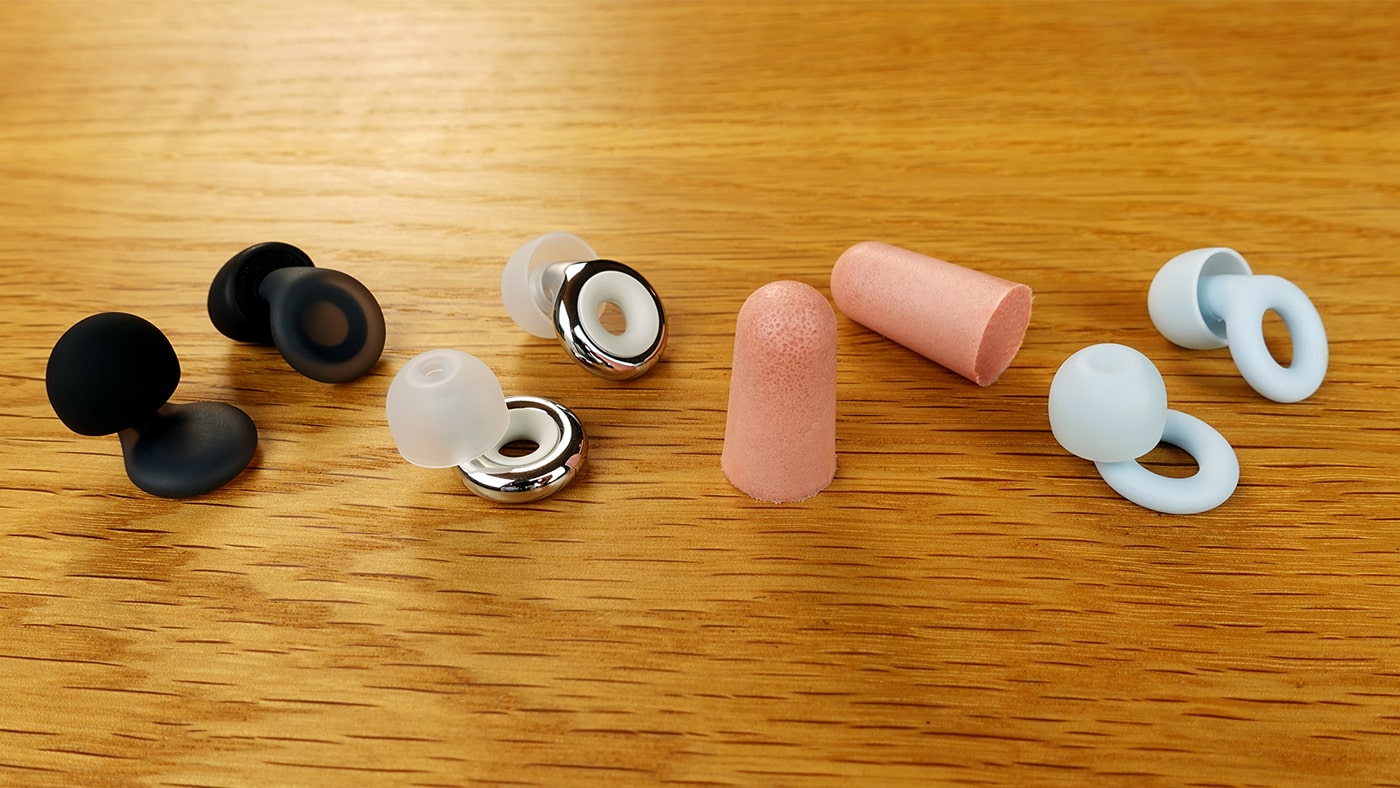
In the photo below, you can see three versions of the trendy Loop earplugs, and my favourite basic foam earplugs, which still block out more noise.
In my experience, it’s hard to beat a really good set of earplugs. There are many to choose from, so you may need to try a couple of brands, styles, or sizes to get the best fit.
The difference between earplugs that fit you well with a noise reduction rating of 33 decibels and earplugs that don’t quite fit or only have a noise reduction rating of 27 decibels is significant. So it’s worth doing your own tests to find the most comfortable and effective ones for your ears.
Some brands I recommend trying because they typically have high noise reduction ratings are Moldex, Howard Leight, Hearoes, Flents, Mack’s, 3M and Ear Buddy. All of these can be bought online and in some stores, especially in the United States.
A while back, I tested and compared Loop earplugs alongside basic foam earplugs. You might find my snoring, music, and barking dogs tests interesting. Even though the Loop are more stylish and modern, the foam earplugs did a better job on the whole.
And if you like foam, take a look at my earplugs article in which I review and recommend multiple brands. It’s a few years old now, but I still use the ones I discussed (Mack’s UltraSoft) and the majority are still available.
Noise-cancelling or sleep headphones
In my experience, there are three main styles of headphones to consider for sleep: headbands, dedicated sleep buds, and standard noise-cancelling headphones.
2024 was a good year for sleep buds as the Soundcore Sleep A20 and Ozlo Sleepbuds came out. They are both very small, with the option to either stream your own music or turn off your phone and listen to sleep sounds or white noise stored directly on the earbuds.
In my tests (which you can see in the articles linked above), I found they both did a good job of blocking a lot of external noise.
In the photo below, you can see from left to right: Soundcore Sleep A20, Ozlo Sleepbuds, Soundcore Sleep A30.
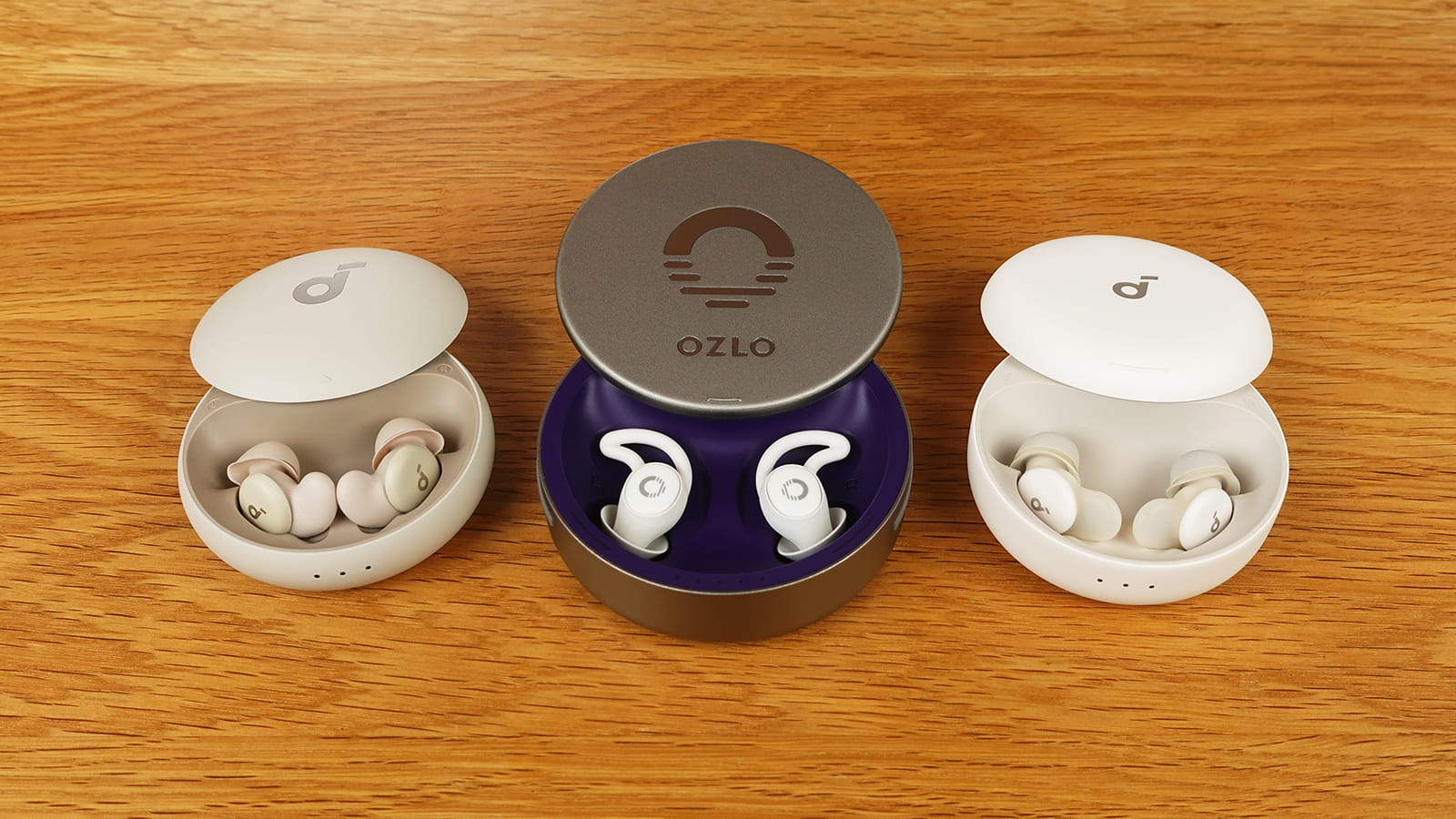
Then in 2025, the Soundcore Sleep A30 came along. To my knowledge, they were the first dedicated sleep headphones with active noise cancellation. It’s not as effective as my new AirPods Pro 3, for example, but it does help and they are good for masking external noise.
You can check out my headphones comparison article for more details on all three of those headphones, as well as some others.
The headband style of headphones typically contain flat or relatively small speakers, and are a good option if you don’t want anything inside your ear canals while sleeping. There are no headbands I know of that have active noise cancellation though, so it’s a case of masking noise with more noise. The Acousticsheep Sleepphones are the best of this style I’ve found so far.
Finally, there are of course many excellent noise-cancelling headphones you could try, especially from companies like Apple, Sony, and Bose. Their larger size means they are less likely to be comfortable when you lie on your front or side, however, so are best suited to predominantly back sleepers. They do give you the option to only have noise cancellation rather than music though, so may be worth trying.
White noise machines or other speakers
White noise or nature recordings can be helpful for masking certain types of external noise. I’ve found they are usually better for blocking noise that’s further away, such as television, music, people talking, birdsong, household appliances, AC units on building exteriors, and distant traffic.
However, they aren’t so effective if you sleep next to someone snoring or if people you live with or upstairs neighbours are stomping around upstairs and creating a lot of impact noise; you might have more luck with earplugs or headphones in those situations.
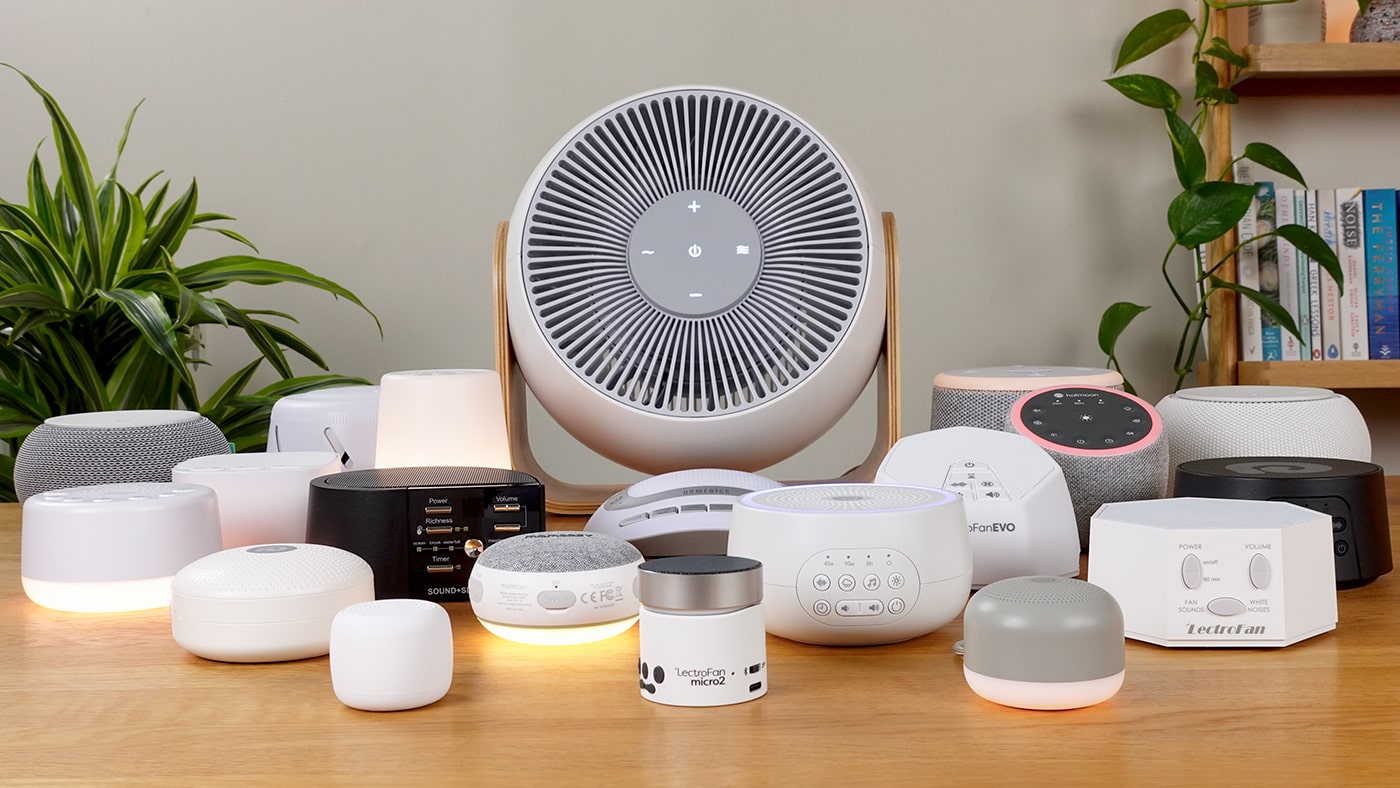
I published a video and article comparing 20 white noise machines, with my recommendations in 10 different categories to help you pick one.
Below, you can see all 20 white noise machines I tested. As you can see, there’s quite a range of sizes and designs!
I also published a video in which I tested seven white noise machines that contain a real fan. You can listen to the type of noise I tried to block and how the machines sound.
You do need to be mindful of the volume and length of time you listen to white noise for. That’s why most white noise machines have an auto-off timer and/or lower maximum volume than traditional speakers.
Another option is to use an app and Bluetooth speaker, or a home smart speaker. This gives you some flexibility to choose other sounds, and the option to use a sleep timer too. If you already have one of those, you can avoid spending money on a new device.
Part 2: Psychological and practical ideas
Coping with a snoring partner
Just to be clear, I’m not a medical professional. However, I feel it would be a lost opportunity not to include a section on snoring and sleep apnea.
If you sleep with someone who snores, I recommend asking them to consider mentioning it to their doctor to rule out sleep apnea. Additionally, there are lifestyle changes and snoring self-help products they could look into. Some can be bought online or in pharmacies, and a doctor or dentist can also recommend good ones.
If your partner is willing to work with you on the problem, it might have a better outcome than you resorting to earplugs for years rather than addressing the underlying cause.
There are also lots of helpful resources available online for snoring. The American Medical Association has a useful article discussing what doctors wish patients knew about snoring.
The NHS website in the United Kingdom has a brief factsheet about snoring. And the British Snoring and Sleep Apnea Association has useful information and guides.
The art of communicating with neighbours or housemates
If someone you live with is making noise that’s disrupting your sleep, it shouldn’t be too difficult to ask them nicely to be quieter - in theory.
In reality, we all have different perspectives on what’s unacceptably noisy, what time is considered late at night, and how well others should tolerate what we do in our own homes.
This means the art of negotiation, or control if you’re a parent, is going to be invaluable. It’s important to ask someone diplomatically to understand that the noise is affecting your sleep, daily life, and well-being.
In my experience, calmly explaining how your life is affected usually gets a better response than just telling someone they are being annoying (even if it’s true). By asking for help and understanding, you’re more likely to get it than if you confront them angrily.
One practical example is to explain to an upstairs neighbour that you can hear them walking around in the morning before going to work, and ask if they’d mind putting their shoes or heels on just before they leave home? They might not have even realised their shoes were making so much noise and be fine with your suggestion.
And if you have a housemate or roommate who keeps you up with gaming noise or watching things on their phone, tablet or TV, asking them to use headphones is perfectly reasonable.
Avoid a sound war
If it’s a neighbour disturbing you, I’d recommend resisting the temptation to enter into a sound war. Again, start with a polite request and continue to ask politely. If you blast your music back at them, nobody wins.
If someone is willing to work with you, try doing some experiments to find the maximum volume they can set a television or stereo to without you hearing it. They could even use a little sticker to mark the maximum volume point.
It might sound like a silly idea or just something nobody really does, but I actually did this with my downstairs neighbour when I was the offending noise creator in my younger days!
Many years ago, my downstairs neighbor told me they could hear my music in the evening and they were working shifts so would appreciate it if I could keep the volume down after 8 p.m.
It only took us a few minutes of playing around with the volume and different songs to find the exact level where the bass wasn’t reaching their ears in bed. And in fact, it wasn’t much lower than I enjoyed listening to anyway, so I was fine with it.
Call the noise busters
This is a more drastic course of action, and won’t earn you any friends: if your neighbours are being continually noisy in a disrespectful way, there may be a local government noise pollution department you can call.
This varies from country to country, but might be the only way to deal with building work on a Sunday morning or constant late-night parties.
Looking up the law where you live can help prepare your case. For example, check online what time builders can start up their power tools, what time fireworks can go on to, how late music can be played in the street.
And while on the topic of making phone calls, if you live in a new build or an old house that was converted into apartments and the soundproofing is terrible, you might find the construction doesn’t meet building regulations.
This would require some investigation, but might be worth it in the long run if you feel comfortable persuading the landlord to fulfil their legal obligations.
Move your bedroom
This might seem like a dramatic course of action, and I know not everyone has enough rooms to simply move their bedroom.
But if your bedroom is next to a main road, a room with a screaming toddler, heavy metal fan, or barking puppy, it might be worth sleeping in a quieter room of your house.
If you don’t have a spare bedroom, and it’s only the occasional night that noise disturbs you, there’s another option: move your bed or even just the mattress to a quiet space in your home when needed.
I’ve personally had no problem carting my mattress into the living room in the past if it meant I actually got some sleep. It’s an instant fix, and I really don’t care how it looks or sounds to sleep on the floor temporarily!
Of course, not everyone is physically able or willing to move a heavy mattress from room to room. In that case, a backup option could be an airbed that you keep in another room. Although it won’t be as comfortable as a normal mattress, you’ll at least have the option to sleep in the quietest spot in your home. If you need to do this often, you could even get a soft foam mattress topper to throw over the airbed to make it more comfortable.
Finally, if you’re staying in a hotel for the night, ask in advance for a quiet room or even to change rooms if the one they give you is noisy. I’ve found hotel staff are usually happy to help if you ask nicely and there are rooms free.
Be prepared for summer noise
Back in June 2023, my 18 year old neighbour came home from the Glastonbury festival with a bunch of friends and decided to continue the party in their garden.
On a Monday night.
It was especially hot that night, so we naturally had the window open. Closing the window obviously reduced a lot of the noise, but it also meant no breeze and a hotter bedroom.
Fortunately, I have a way to cool my bed and bedroom, so I was able to sleep okay with the window closed for one night, even though I prefer to keep it open.
It did get me thinking though. I realised that it can be noisier in the summer, both in urban areas and in the countryside where birds and other animals wake early and make all sorts of noise.
So, perhaps the trick in the summer is to at least have a fan and lighter bedding at the ready. The fan sound might even help mask other noise that’s keeping you awake.
Why didn’t I ask my neighbour to turn off their Monday night drum and bass? Because I was 18 once too, and it was (hopefully) a rare event. Besides, they were so drunk, I don’t think my complaint would have done much good! So I just stuffed in some earplugs and did my best to relax and fall asleep.
Mind over noise
In my experience, sleep problems can easily end up in a vicious circle. The stress of being kept awake by noise can itself turn into a worry that you won’t sleep. That worry can then become the reason you can’t sleep.
And if the person or thing making the noise makes your blood boil and fills you with rage, that’s a problem; it’s very hard to relax and fall asleep when your head is swimming with angry thoughts.
How do you adjust your own reaction to the noise? One approach is to try and control how much you allow yourself to be upset by noise at night. How you go about doing that though can come down to several factors.
If you’re prone to stress or anxiety, I know it can be hard to let go of noise disturbances. Trying to adopt a new attitude that you forgive (or at least tolerate) whoever or whatever is making the noise, and that you can learn to sleep with it can take time.
It’s not impossible though, and you may find you eventually become accustomed to certain sources of noise, such as traffic, and learn to sleep with it. I know the steady drone of traffic isn’t the same as an unexpected party next door at 2 a.m. But in that case, reminding yourself that it doesn’t happen every night might be the best tactic.
Personally, I try to take a few deep breaths to refocus my brain away from wishing I had Jedi powers so I could melt my neighbour’s speakers. It might sound over-simplistic, but focusing on your breathing is often a simple and effective way to reduce the impact of negative thoughts.
Body over noise
My experience has always been that I sleep better when I engage in daily activities that tire me out physically and mentally - even if it’s noisier than I’d like it to be.
I know from spending years observing my own sleep, and how different factors impact it, that when I go to bed feeling ready to sleep, I’m much more likely to sleep through noise than when I go to sleep with excess energy I haven’t managed to burn off.
So try to stay active, both physically and mentally.
Part 3: Thoughts on soundproofing a bedroom
Finally, we come to the most involved ideas for dealing with noise at night, both practically and potentially financially depending on the lengths you’re willing to go to.
I’ve left this part to the end simply because it’s not my area of expertise. I spend my time testing and reviewing sleep products, not building clever soundproofing walls!
However, I have done some of the less invasive steps below, and found them very effective. Additionally, I’ve spent many hours watching videos, reading articles, and speaking with my sister who is an architect and my cousin who is a sound engineer to understand what’s involved in soundproofing a bedroom.
So, I highly recommend doing a good amount of research yourself before embarking on any of the DIY tasks below, and consulting a professional if they are beyond your skillset.
Why soundproof your bedroom?
Sound has an astonishing ability to find its way through the smallest of gaps. It doesn’t just travel through the air either - it also travels through solid materials as vibration. That’s why you can sometimes hear bass, footsteps, or even a washing machine through the structure of the building itself.
Because of this, properly soundproofing a room is rarely simple. If the original construction didn’t isolate sound very well, fixing it afterwards can be expensive, disruptive, and sometimes not even allowed if you’re renting.
If you have the budget, one option is to hire an acoustic consultant. Searching for “acoustic consultant near me” will usually bring up local companies who can assess your home and give tailored advice. Just be aware that professional soundproofing work can be costly, and even then it might not eliminate every bit of noise.
Before going that far, there are some less extreme steps you can try.
First, a common myth
You may have seen foam panels advertised online as “soundproofing.” The thing is, they aren’t very effective at stopping noise from coming into your bedroom.
Acoustic foam reduces echo inside a room. It’s useful for recording audio or improving clarity, but it does very little to stop noise coming through walls from neighbours or traffic.
To block sound from entering or leaving a room, you generally need:
- Better sealing.
- More mass.
- Or structural separation.
While adding mass does help reduce airborne sound, foam panels are simply too light to make any meaningful difference. Even a bookshelf full of books can provide some actual weight and density; foam has a minimal impact.
So if your goal is better sleep in a noisy home, foam panels are unlikely to solve the problem.
Start with the simple wins
Seal gaps and cracks
If you can feel air coming through a gap, sound can get through too. If you can see light around a door or window frame, for example, then you’re losing sound insulation there too.
So check these areas of your bedroom:
- Window frames.
- Door frames.
- Skirting boards.
- Floorboards.
- Any visible cracks or seams.
Using an appropriate acoustic sealant can be inexpensive and surprisingly effective. In many cases, sound leaks through small openings more than it passes directly through solid walls.
Use a door sweep or draft excluder
Interior doors are often one of the weakest points in a bedroom when it comes to sound travelling around the inside of a house.
Adding weatherstripping around the frame and a door sweep (also called a draft excluder) underneath can reduce the amount of sound coming through the gaps. I’ve used a door-length fabric draft excluder (mine happens to be shaped like a sausage dog), and even that can take the edge off noise.
Even just rolling up a towel and placing it at the bottom of the door can work, such as when staying in a hotel or someone else’s house for a few nights.
It won’t make the room silent, but it can reduce the sharpness of voices, general household noise, and people walking past your bedroom.
Hang heavy curtains (with realistic expectations)
Hanging heavy curtains or blackout drapes over the windows might slightly reduce higher-frequency noise and improve the sense of quiet in your bedroom.
However, they won’t dramatically block loud traffic or deep bass from music. And as always, make sure any materials you hang are fire-safe.
Add mass where you can
Airborne sound, such as voices or television noise, is best blocked by mass.
You can add some mass in renter-friendly ways by placing furniture against the wall where most sound is travelling through. It won’t block everything, but it may slightly reduce how clearly you hear it. Every little helps.
Try these along the offending noisy wall:
- Full bookshelves.
- Wardrobes.
- Cupboards.
If the problem is footsteps from above
Footsteps and furniture dragging are a different type of noise. They travel through the building as vibration rather than just through the air.
If you have control over the room above you, adding thick carpet, dense underlay, or heavy rugs can make a noticeable difference.
If you don’t control the upstairs space, unfortunately there’s less you can do without major work.
One small tip you could try in this situation is reducing how much vibration reaches your bed itself. Putting thick squares of neoprene or heavy-duty rubber anti-vibration pads under your bed legs may slightly reduce how much vibration travels into the bed frame while you’re lying in it. It won’t solve the problem entirely, but it’s a relatively simple thing to experiment with.
Intermediate improvements
If sealing gaps and rearranging furniture isn’t enough, the next step usually involves more extensive steps to increase mass or improve window insulation.
Replacing a hollow-core door with a solid-core door can help reduce voices and general household noise.
If traffic noise is the issue, adding a properly fitted window insert creates an extra air gap, similar to double glazing, which can significantly reduce airborne sound.
These changes cost more than sealing gaps, but they can be effective.
Major structural changes
If you want serious sound reduction, especially for persistent neighbour noise or bass from music, then major structural changes might be required, which goes beyond simple DIY.
To significantly improve a wall’s soundproofing, two things help:
- Increasing the mass of the wall.
- Reducing vibration travelling through it.
For example, adding extra layers of acoustic plasterboard increases mass and can reduce airborne noise.
Even more effective is building a new stud wall in front of the existing wall, leaving a gap between them. That gap makes it much harder for vibration to travel from one side to the other.
However, these steps aren’t without downsides to consider:
- A secondary wall can reduce the size of your bedroom.
- It can be expensive.
- It may require professional installation, raising the cost even more.
- It might not even be allowed in rented properties.
I would think very carefully before investing in major structural soundproofing and get expert advice unless you really know what you’re doing.
A room within a room? Maybe, with expert help
Over the years, many readers have told me they feel stuck. They can’t move rooms. They can’t control the neighbours. And the noise, especially from upstairs, feels relentless.
I once asked my cousin, who runs his own recording studio, whether there’s a simple material you can just plaster over the walls to shut out all sound, like in a studio. Sadly, he told me there isn’t.
Studios work because they’re built with layers of mass and physical separation. In some cases, they are effectively a room built inside another room, with structural gaps designed to stop vibration transferring through the building.
In theory, you could create something similar in a home bedroom. In practice, it’s a major job that requires money, space, and serious DIY skills or professional help. There may also be building regulations and fire safety issues to consider.
Personally, although the idea sounds appealing in principle, it’s not something I’ve tried or plan to try. The cost, effort, and loss of space would put me off.
I’ve only included it here as a point of interest for those who are curious about the most extreme solutions. If you’re considering anything on that scale, as I keep saying, I strongly recommend getting professional advice first.
Further reading
Despite my focus on coping strategies for dealing with nighttime noise in this article, it’s important to acknowledge the potential adverse effects that noise can have on our sleep quality. Insufficient sleep or poor sleep quality can lead to negative health outcomes.
There have been numerous scientific studies conducted on the impact of noise on sleep that you might find interesting. My intention isn’t to alarm you, but they might help you decide how important it is to tackle the noise problem you have.
This article in 2014 looks into the cardiovascular consequences of environmental noise exposure.
A comprehensive review in 2018 considers a broad range of studies examining the impact of noise on sleep.
This article in 2022 looks at the impact of environmental noise on children’s sleep habits.
An article on the World Health Organization website has recommendations for the acceptable noise levels in bedrooms - ideally less than 30 A-weighted decibels.
Your views
Does noise keep you awake at night? Feel free to share your story or vent your frustration in the comments below.
And if you have any useful techniques for coping with noise at night, I’d love to hear them.


Hoặc